Madhaaf / History study 01
Across the ocean: Kutchi histories in Kenya and Ethiopia
Trade, settlement and belonging before British rule, during empire and after independence. A source-led study of the routes connecting Kutch, Kenya and Ethiopia.
Historical research synthesis · Open references · Not independently peer reviewed
Explore the migration map
Abstract
Kutchi migration to East Africa developed through overlapping journeys, commercial networks and family connections. This study places Kenya at its centre and compares its history with Ethiopia. British and French reports, Kenyan gazettes, court records, museum research and oral histories document commerce, residence and family life. An 1873 consular letter reports Memon arrivals in Mombasa around 1853; separate administrative statistics record Bohra women and children in Mombasa and Lamu in 1870. These records strengthen a nineteenth-century chronology before the East Africa Protectorate, while leaving earlier settlement open to investigation. Ethiopia requires a different chronology and greater caution about regional origins. The study distinguishes regional origin, language, religion and nationality, and records the limits of each source.
Keywords: Kutch, Kutchi diaspora, Mombasa, Kenya, Ethiopia, Zanzibar, Indian Ocean, migration
The chronology and its limits
| Period | Evidence | Limit |
|---|---|---|
| c. first century CE | Periplus describes connected African, Arabian and Indian markets.[1] | Regional exchange; no identified Kutchi community. |
| 1498 | Voyage journal records Indian vessels at Malindi.[30] | Indian visitors; no demonstrated Kutchi identity or household settlement. |
| 1810 | Zeila trade return names cloth from Cutch and outward goods from Harar.[26] | A three-year trade summary, not an annual migration count. |
| 1820s–1830s | Goswami identifies growing Kachchhi trade on the East African coast.[3] | Regional overview; not a first-arrival date for Kenya. |
| 1835–1837 | A Kachchhi-Gujarati chart, Burnes's voyage report and Leech's memoir document seafaring connections with the Horn and Zanzibar.[27][28][31] | Navigation and commerce; not proof of Ethiopian or Kenyan household settlement. |
| 1846–1848 expedition | Guillain describes Kutch-linked firms, rotating coastal agents and ships trading at Mombasa.[37] | Firms and temporary residence; each agent's origins and household are unspecified. |
| c. 1853, reported in 1873 | Memon leaders tell Kirk that arrivals began twenty years earlier.[34] | Approximate community recollection; no date for arrival of wives or children. |
| January 1857 | Burton and Speke identify a customs-house official from Cutch at Wasini.[25] | Individual presence and employment; arrival date and household unknown. |
| c. 1860s or earlier | 1915 judgment retrospectively describes Memon migration and family settlement in Mombasa.[6] | Reported approximate dates; specific to the families and community discussed. |
| 1870 statistics | Bohra population table records adults, children and houses in Mombasa and Lamu.[36] | Reproduced in 1906; no Kutchi birthplace or language breakdown. |
| Late nineteenth century | Harre's family interviews include Kutch among origins of migrants to Ethiopia.[14] | Kutchi-specific numbers and earliest settlement remain unknown. |
| 1923–1963 | Kenyan gazettes record Mandvi dhow cargo and families connected with Kutch villages and Nairobi.[38][39][40] | Separate shipping, estate and birth records; no common arrival date or language count. |
| 1960s–1970s | Citizenship restrictions in Britain and nationalisation in Ethiopia reshape migration.[14][19][20][41] | Different national histories; broad Asian/Indian categories. |
1. What the records can tell us
I began this study with the question of how far back the Kutchi presence in Kenya can be traced. The answer depends on what we count as evidence. A ship carrying Indian textiles establishes a trading connection. A record identifying a migrant's place of origin can establish a connection with Kutch. A family living in Mombasa establishes something further: settlement. These are related histories, but they require different evidence.
Kutchi refers here to people connected with Kutch, also written Kachchh, Cutch or Cutchi in the sources, and to the language associated with that region. Regional origin, home language, religious affiliation and nationality do not always coincide. Records filed under Indian, Asian, Gujarati, Khoja, Memon or Banian therefore cannot simply be counted as records of Kutchi speakers. Older spellings are retained in source titles; historical classifications are not adopted as neutral descriptions.
This is a historical synthesis of accessible published and documentary material, including digitised nineteenth-century records. I have not conducted new interviews or visited archival repositories for this article. Where only a publisher's description or an abstract was accessible, that limit is identified in the bibliography. Community histories are used as accounts of how organisations describe their own past. They are not treated as a census or a complete chronology of the diaspora.
The expanded investigation covers Kenyan government publications and archival finding aids, British India Office and parliamentary records, European collections, and museum and heritage documentation. Searches use historical spellings including Cutch, Keutch, Kutchi, Cutchi, Mombassa and Lamo. The results are necessarily partial: many relevant holdings are catalogued without online images. A catalogue identifies material to retrieve; conclusions about its contents require inspection. An unsuccessful search does not establish that a record never existed.
Kenya and Ethiopia also need to be read on their own terms. In Kenya, British rule reorganised an existing coastal world. Ethiopia's connections developed through its own state, commercial centres and relationships with neighbouring ports. A single timeline labelled British migration would obscure those differences.
2. The older ocean, before a documented Kutchi diaspora
The earliest written context considered here is the Periplus of the Erythraean Sea, a merchant's account from around the first century CE. It describes Adulis on the Red Sea, ports along the East African coast and western Indian trading centres including Barygaza. Its account of ships, cargoes and sailing seasons places these coasts within a connected commercial world. It does not identify a Kutchi community in Mombasa or Ethiopia. Ancient trade cannot supply a founding date for today's families.[1]
A later voyage account supplies a more local reference. The journal of Vasco da Gama's first voyage records four Indian vessels at Malindi in April 1498. Its narrator called their occupants Christians, a classification the edition's notes question. This establishes Indian maritime visitors at a port in present-day Kenya before British rule. Neither that description nor the editor's separate identification of a Gujarati pilot establishes a Kutchi colony. The journal's Malindi evidence should not be relocated to Mombasa.[30]
Edward Alpers's study of Gujarat and East African trade covers the period around 1500 to 1800. Its published abstract identifies Gujarati Hindu and Jain merchants, especially Vanias, as important participants in Indian Ocean commerce. That helps establish the older regional setting. Gujarat is a wider category than Kutch, however, and activity somewhere on the East African coast does not by itself establish residence in the places now within Kenya.[2]
Chhaya Goswami's work brings Kutch into clearer focus. Her Oxford research overview describes an established maritime tradition and growing Kachchhi commercial prominence on the East African coast in the 1820s and 1830s, linked to Omani expansion. Her book on the period 1800 to 1880 examines connections among Mandvi, Bombay, Muscat and Zanzibar, including credit and finance. The accessible overview and publisher's account support a substantial nineteenth-century network, without identifying the first Kutchi arrival in Kenya.[3][4]
Textiles help explain what sustained those journeys. Sarah Fee's research traces a shift around 1800 towards Kachchh in the production, procurement and shipping of cloth for eastern Africa. Mandvi's links reached into its manufacturing hinterland. African buyers selected particular materials, colours and woven structures, and their preferences shaped what merchants could sell. The surviving trade was therefore sustained by weavers, dyers, buyers and local political relationships as well as shipowners. Fee's combination of objects, archival records and field research provides firmer evidence for that commercial world than a general claim of ancient cultural ties.[24]
An older report makes the shipping connection concrete. Robert Leech's 1837 memoir, printed in the Bombay government's records in 1855, describes about six vessels trading between Mandvi and Zanzibar. It names the Batella and Gambeera and gives an annual cycle of departure in December and return in April. Outward cargo included cloth, ironwork and cumin; returning goods included ivory, hides and wax. This is a contemporary commercial account, not a passenger list. Its Zanzibar connection cannot by itself establish when households settled in Kenya.[27]
The distinction matters for the historical claim. The evidence reviewed here reaches back to antiquity for the setting of exchange, and much more securely into the nineteenth century for identifiable Kutchi networks. It leaves earlier family settlement in Kenya open to investigation. It does not justify a claim of two thousand years of continuous Kutchi settlement.
3. Before the Protectorate: Kutch, Zanzibar and Mombasa
Before British rule needs a precise meaning. Mombasa briefly came under British protection in 1824, following Captain William Owen's intervention, and that protection was withdrawn in 1826. The East Africa Protectorate began in 1895. These dates, documented by British Library historian Mark Hobbs, distinguish an early intervention from the much later establishment of sustained British colonial administration. British influence elsewhere in the ocean also preceded 1895.[5]
Owen's own published narrative describes a substantial group classified as Banyans in Mombasa during the short British intervention. It also records seasonal exports of ivory and other produce to Bombay in exchange for manufactured goods. This is direct evidence that an Indian commercial presence preceded the later Protectorate and railway. The passage does not identify those merchants as Kutchi. Its claims that British occupation brought justice belong to the narrative's justification of imperial intervention, not to a neutral account of coastal society.[32]
Charles Guillain's French expedition of 1846–1848 records another form of residence. He describes Zanzibar merchants linked to large Kutch and Bombay firms, employing agents in Lamu, Mombasa and other coastal towns for two or three years before replacing them. His Mombasa account also records ships owned by merchants of Kutch and Bombay carrying ivory to India. These passages establish connections between firms, agents and ports. They do not identify every agent's birthplace, or show that a commercial posting became a permanent family home.[37]
John Kirk's letter of 6 November 1873 supplies an earlier reported chronology for Memons. Community leaders told him that arrivals in Mombasa began twenty years earlier, approximately 1853. He described growth from two houses to thirty and linked the community with Kutch and Sindh. Separately, he described merchants working seasonally in Malindi while their wives and families lived in Mombasa. This establishes family residence by 1873. It does not date those families' arrival to 1853. His report arose from an investigation of slaveholding and British consular authority.[34]
A dated observation identifies a person from Kutch on the Kenyan coast in January 1857. In their report published the following year, Richard Burton and John Hanning Speke describe a young Cutch Bohrah managing the customs house at Wasin, now Wasini. They also mention a trader of the same community buying cowries. The explicit regional description is useful evidence of presence and employment. It does not identify the official's name, arrival date, household or descendants. The authors' hostile racial descriptions elsewhere in the account also require a critical reading rather than acceptance of their social judgments.[25]
An administrative table labelled 1870 makes women and children visible in two coastal Bohra populations. It survives in Saldanha's 1906 compilation, which identifies its source as the Zanzibar Agency's administration report. The adjoining account discusses migration from Kutch, but supplies no birthplace or language breakdown for these residents. The figures below therefore retain the source's Bohra category. Its final column counts houses, without establishing a one-to-one relationship between a house and a family.[36]
For household settlement, a particularly clear documentary example is Abdurahim Haji Ismail Mithu v. Halimabai, decided in December 1915. Paragraph 3 places Memon migration from Cutch to East Africa more than half a century earlier and reports at least a hundred Memon families in Mombasa. Paragraph 4 describes the deceased merchant's father moving there with his wife and children about half a century earlier. Read retrospectively, this points to migration by approximately the 1860s or earlier. It is a reported chronology in litigation, not a passenger register or a date for the first arrival.[6]
The judgment is also evidence of family life. A widow's claim to a share of her husband's estate brought questions of inheritance, religious law and migration before the courts. Women and children appear here within a household history, rather than as people who entered the story only after men had finished building businesses. The case is specific to Memon families and cannot establish the same chronology for all Kutchi groups.[6]
Gervase Clarence-Smith describes the nineteenth-century rise of merchants from Kutch across the Omani trading world, including Hindu Bhatias, Khojas and Memons. His account shows connections between people classified into different religious communities, including business relationships linking Tarya Topan and the Bhatia customs-farming firm of Jairam Shivji. These categories describe different affiliations within a wider commercial world; they should not be collapsed into one religion or one uniform migrant experience.[7]
Zanzibar belongs in a study centred on Kenya because it was one of the major centres through which Kachchhi commerce developed. The network connected ports, firms and credit arrangements across the ocean. It should not be read as a compulsory itinerary followed by every migrant. Establishing whether a particular Mombasa family travelled directly from India, through Zanzibar or through another port still requires that family's records.[3][4]
There are earlier claims worth pursuing without silently turning them into established dates. Cynthia Salvadori's account of Kenyan mosques names a Badala captain, Jusub Adam, as settled in Mombasa by 1705. The article does not supply a document citation for that particular statement, and I have not independently verified it. It remains a specific lead for research into family, mosque and port records. It is not used here to date the founding of the community or to draw an eighteenth-century migration route.[29]
Recorded Bohra residents, 1870[36]
| Place | Adult men | Adult women | Children | Total | Houses |
|---|---|---|---|---|---|
| Mombasa (Mombassa) | 39 | 33 | 70 | 142 | 25 |
| Lamu (Lamo) | 20 | 14 | 8 | 42 | 11 |
The table records a religious community. It does not supply a Kutchi population count. Houses retain the source's meaning and are not counted as families.
Read the routes
An ocean of connections
Choose a period or play the sequence. Lines show selected connections, with evidence and limits below. On small screens, scroll the map sideways.
1800–1895
Before the Protectorate
Kachchhi commercial networks and evidence of settlement before sustained British administration in Kenya.
- Mandvi and Muscat. Commercial connection in Goswami's account; the line does not reconstruct a particular voyage. [4]
- Mandvi and Zanzibar: 1837 trade account. Leech describes an annual trading cycle, outward in December and returning in April. This connection is commerce, not a household migration or an exact sailing track. [27]
- The Veerasil's 1835 voyage. Burnes records Mandvi, al-Shihr, al-Mukalla, Aden and Berbera. Only Mandvi and Aden are shown here; the other stops are not plotted. A commercial voyage, not an Ethiopian settlement route. [31]
- Muscat and Zanzibar. Ports within the Kachchhi trading network. Exchange was reciprocal, so no migration arrow is assigned. [3][4]
- Kutch to Mombasa. Kirk's 1873 letter reports Memon arrivals around 1853 and family residence by 1873. The 1915 judgment adds a family chronology. Mandvi represents Kutch; embarkation and intermediate stops are unknown. [34][6]
Schematic connections, not exact voyages, railway alignments or measured flows. The periods overlap. Place names and coastlines use modern reference geography. London represents Britain; Mandvi sometimes represents Kutch. Equal line widths carry no population meaning. Coastline: Natural Earth, public domain, 1:110m land, simplified for display. No historical borders are implied.
Read all map connections as text
1800–1895: Before the Protectorate
Kachchhi commercial networks and evidence of settlement before sustained British administration in Kenya.
- Mandvi and Muscat. Commercial connection in Goswami's account; the line does not reconstruct a particular voyage.[4]
- Mandvi and Zanzibar: 1837 trade account. Leech describes an annual trading cycle, outward in December and returning in April. This connection is commerce, not a household migration or an exact sailing track.[27]
- The Veerasil's 1835 voyage. Burnes records Mandvi, al-Shihr, al-Mukalla, Aden and Berbera. Only Mandvi and Aden are shown here; the other stops are not plotted. A commercial voyage, not an Ethiopian settlement route.[31]
- Muscat and Zanzibar. Ports within the Kachchhi trading network. Exchange was reciprocal, so no migration arrow is assigned.[3][4]
- Kutch to Mombasa. Kirk's 1873 letter reports Memon arrivals around 1853 and family residence by 1873. The 1915 judgment adds a family chronology. Mandvi represents Kutch; embarkation and intermediate stops are unknown.[34][6]
1895–1963: Colonial Kenya
Further community migration and the inland railway corridor. Railway recruitment involved a wider population than Kutchi migrants.
- Further settlement in Kenya. The Nairobi Samaj's account places ancestral migration in the 1890s and further settlement after the Second World War. Mandvi is a regional reference.[21]
- Mombasa and the interior. Simplified railway corridor; broader Asian and African labour history, without a Kutchi-specific passenger count.[11]
- Towards Lake Victoria. Kisumu marks the lake end of the corridor. This line is not a reconstruction of the track alignment.[11]
Late 1800s–1970s: The Ethiopian connections
An overlapping chronology: broader Indian migration through Aden and the Horn. Kutch is among recorded origins, but every leg cannot be assigned to Kutchi families.
- Bombay to Aden. A documented pattern in Indian family accounts. Some migrants lived and worked in Aden before continuing.[14]
- Aden and Djibouti. One connection in the wider Red Sea network, with varied individual itineraries.[13][14]
- Ports and Harar. Schematic inland connection; the network also used other ports, including Zeila. It is not an exclusive route.[13]
- Harar and Addis Ababa. Centres of Indian commerce and craftsmanship. The line summarises a network, not a journey taken by every family.[15][16]
Since the 1960s: Onward migration and continuing homes
Britain was one destination in the wider Kenyan Asian diaspora. Communities also remained in Kenya. No Ethiopian onward route is plotted without family-level evidence.
4. Trade, slavery and the people missing from merchant histories
A history of commercial achievement also has to account for the systems in which that commerce operated. Farhana Ibrahim's study of Kutch, migration and marriage examines the participation of Kutchi merchants in slaveholding and slave trading, and the disputes over British jurisdiction that followed. It shows how colonial officials distinguished domestic slavery from slave dealing and sometimes permitted the former. Those administrative distinctions did not remove coercion from the lives of enslaved people.[8]
Leech's trade memoir also records the purchase and movement of enslaved people between Zanzibar and Kutch. Its wording is qualified: it describes a trade that existed or had previously existed, rather than providing an unambiguous current annual count. The same compilation reproduces a proclamation dated 6 February 1836 against importing enslaved people into Kutch. A prohibition records an official intervention, not proof that trafficking ended. These documents need to be read together, without converting uncertain estimates into precise totals.[27]
Ibrahim's evidence also makes women's movement visible. Colonial correspondence classified African women travelling towards India through competing categories of wife, enslaved person and trafficking victim. Those categories were contested and affected what officials did to the women concerned. A route drawn across the ocean can therefore represent profoundly different experiences: commercial opportunity for one traveller, displacement or restricted freedom for another.[8]
The archive also contains arguments over responsibility. Kazi Shahabudin, Dewan of Kutch, compiled a memorandum in February 1870 from an unnamed Bhatia trader's observations during 1859–1866. It lists Lamu and Mombasa within a network connected with Kutch, Bombay and other Indian regions. The informant explicitly calls his population figures rough estimates. His denials of participation in slavery belong to this contested debate and require corroboration. They cannot be read as proof that coercion had ended.[35]
Museum collections can recover a named woman's movements through other kinds of evidence. Julia Stephens identifies Janbai as a Kutchi-speaking woman whose life connected Zanzibar and Bombay. Her study combines family and legal records with a bracelet and portrait held by the Peabody Essex Museum. The objects passed through the Batchelder family before entering the museum in 1932. They preserve traces of Janbai's relationships with women, although parts of their accompanying family history were lost. Her household also relied on enslaved women. This is a regional comparison, without a demonstrated Kenyan itinerary.[43]
The African setting must remain equally visible. In the introduction to Inland from Mombasa, David Bresnahan describes Mijikenda-speaking societies supplying goods, negotiating alliances and influencing Mombasa's political relationships. They appear as participants with bargaining power. A Kutchi diaspora history belongs within that African history, with attention to the communities whose work and decisions helped sustain oceanic commerce.[9]
The sources used here favour people whose property, disputes and businesses generated records. They reveal less about small traders, sailors, porters, domestic workers and women whose names did not enter those records. That imbalance limits what this article can say about the social composition of the community. It also identifies where future research should begin.
5. Under British rule: labour, commerce and political belonging
The establishment of British administration in 1895 changed the scale and conditions of migration to Kenya. Sana Aiyar's research, discussed in an MIT interview accompanying Indians in Kenya, places railway workers alongside traders and later generations negotiating an unequal colonial society. The commercial networks that preceded formal rule continued within an expanding imperial economy. Indian residents could gain opportunities within that system while also experiencing racial exclusion.[10]
Railway labour is essential to this period, but it cannot stand for the origin of every Kutchi family. The National Railway Museum describes a workforce recruited from British India, substantially from Punjab, and the abusive conditions under which the railway was built. It records that thousands remained in East Africa after construction. Those figures concern a broader Asian workforce. Without evidence of language or birthplace, they cannot be converted into a count of Kutchi migrants.[11]
The railway also needs to be understood through African labour and the violence of colonial expansion. The museum's account includes deaths among African workers as well as those recruited from India. Disease, exposure and the pressure to reduce costs belong in the history of the line alongside engineering. A migration map cannot measure that human cost, and the railway line shown here indicates a corridor rather than individual journeys.[11]
Sea connections continued alongside the railway. A Mombasa customs notice published on 2 January 1924 lists unclaimed cargo from a dhow recorded as coming from Cutch Mandvi on 22 May 1923. Its cargo included red chalk. This small entry documents a continuing maritime connection during colonial rule. It records goods, without identifying passengers or the crew's language.[38]
Official records also show how family connections extended across borders. A 1961 probate notice describes Nairobi resident Mavji Jivraj Vasta Patel, his death in Uganda, and his widow Dhankuvar living in Mankuva, Cutch. Her attorney applied in Nairobi to administer the estate. The notice establishes those relationships and locations, while leaving each person's migration history open. The widow's residence in Kutch does not establish that she had previously lived in Kenya.[39]
A 1963 deed-poll notice supplies a different family record. Karsan Keshra of Nairobi identifies three daughters: one born in Bharasar, Cutch, in 1944 and two born in Nairobi in 1952 and 1954. These recorded birthplaces connect a named family with both places. They do not establish a single permanent move between the births, since family members could travel repeatedly. No language is recorded in the notice.[40]
Aneesa Kassam's account of an early Kenyan Indian settler offers a different scale of evidence. Built from family testimony and other records, it follows an individual life through colonial society and discusses involvement in the struggle against British rule. Its method is useful for Madhaaf: a named life can be checked against the institutions and events surrounding it, while keeping retrospective family testimony identifiable as testimony.[12]
There was no single Indian political position. Aiyar describes people benefiting from some aspects of empire and opposing it in others, including support for the anti-colonial struggle. That complexity prevents a simple division of the population into colonial agents on one side and people wholly outside colonial structures on the other. Kutchi histories need the same attention to differences of occupation, class and political choice.[10]
A parliamentary exchange of 30 October 1918 gives direct evidence of the conditions surrounding residence. Josiah Wedgwood questioned the segregation of Indians in Mombasa and their access to residential land. William Hewins acknowledged representations from Indian associations and defended the measures through sanitary arguments. The exchange documents both protest and an official justification for unequal treatment. It concerns Indians broadly and does not identify the participation of particular Kutchi families.[46]
6. Ethiopia: the Red Sea routes and the limits of identification
A trade return collected at Zeila in March 1810 provides an early, explicit connection with Cutch. Published in Henry Salt's A Voyage to Abyssinia, it lists 200 bales of coarse cloth from Cutch among imports and coffee and hides from Harar among the port's outward goods. The return was supplied by a local official to Mr Stuart and summarised three years, not one year's trade. Zeila was a coastal gateway outside the Ethiopian interior. The record establishes goods and a connected market, not the birthplace or home language of its merchants.[26]
Ethiopia's history requires a separate frame. Richard Pankhurst documents nineteenth- and early twentieth-century Indian commerce around the Red Sea and Gulf of Aden, with merchants at coastal ports and goods reaching far into Ethiopia. Textiles and spices moved inland, while gold and ivory entered outward trade. The movement of goods is evidence of a commercial connection; it does not establish that the traders all came from Kutch or that they all settled in the Ethiopian interior.[13]
A surviving navigational manuscript adds a different kind of evidence. John Cooper and Kumail Rajani analyse a Kachchhi-Gujarati chart of the Red Sea and Gulf of Aden, now held by the Royal Geographical Society. Acquired in 1835, it probably dates to the eighteenth or early nineteenth century. It preserves sailors' practical knowledge, not a record of Ethiopian household settlement. The chartmaker's name remains unknown.[28]
Alexander Burnes's original report provides a named voyage. In early 1835 the Veerasil sailed from Mandvi through al-Shihr, al-Mukalla and Aden to Berbera. Burnes obtained the chart from its pilot and travelled aboard the vessel from Bombay to Kutch in May. He describes a mixed crew and a Hindu managing the cloth cargo's sales. These details show a working maritime network before Britain's occupation of Aden in 1839. They do not establish permanent settlement in the Ethiopian interior, and Burnes's racial classifications should not be mistaken for the crew's own account of their identities.[28][31]
The cloth connection can also be traced inland. Burton's account of his January 1855 stay in Harar describes gate duties assessed in lengths of Cutch canvas. This is a more specific material link than a general resemblance between Indian and Harari buildings. It identifies cloth used in a local fiscal practice, not the origins of the people who brought it there. The account's pervasive racial stereotypes are not accepted as descriptions of Harari or Somali character.[33]
Dominique Harre supplies more direct evidence of origins. Interviews conducted for her study of migration between Yemen and Ethiopia identify Kutch among several Gujarati regions from which families came. She also describes Aden as a place of residence and employment before later movement into the Horn, sometimes after years rather than a brief stop. This supports a connection with Kutch and a history of migration in stages. It supplies neither a complete count nor one route shared by all families.[14]
The full text of Harre's study of G. M. Mohamedally & Co makes the regional distinction clearer. It identifies the founder, Mohamedally Shaikh Sharafaly, and his partner Abdullabhai Mohamedally Kera as originating in Sidhpur, Gujarat, not as documented Kutchi migrants. A letter dated 17 May 1940 recalls the founder leaving India around 1885 and working for about ten years for the Aden firm Menahem Messa. His son's retrospective account places his move via Berbera to Harar around 1893 or early 1894. These are different sources with approximate dates, not one exact chronology. Harre follows the company's development to its expulsion in 1937 and identifies the archival files behind her account.[15]
Material evidence can provide a name and date where family papers are missing. In a separate paper, Harre discusses an inscription recording the carpenter Mistri Syaram's completion of a door at the Sheikh Abadir shrine in Harar on 7 November 1892. She interprets the Hindi inscription as suggesting an origin outside the Gujarati majority described in her study. The example is particularly useful because it shows why Indian craftsmanship in Ethiopia should not automatically be labelled Kutchi.[16]
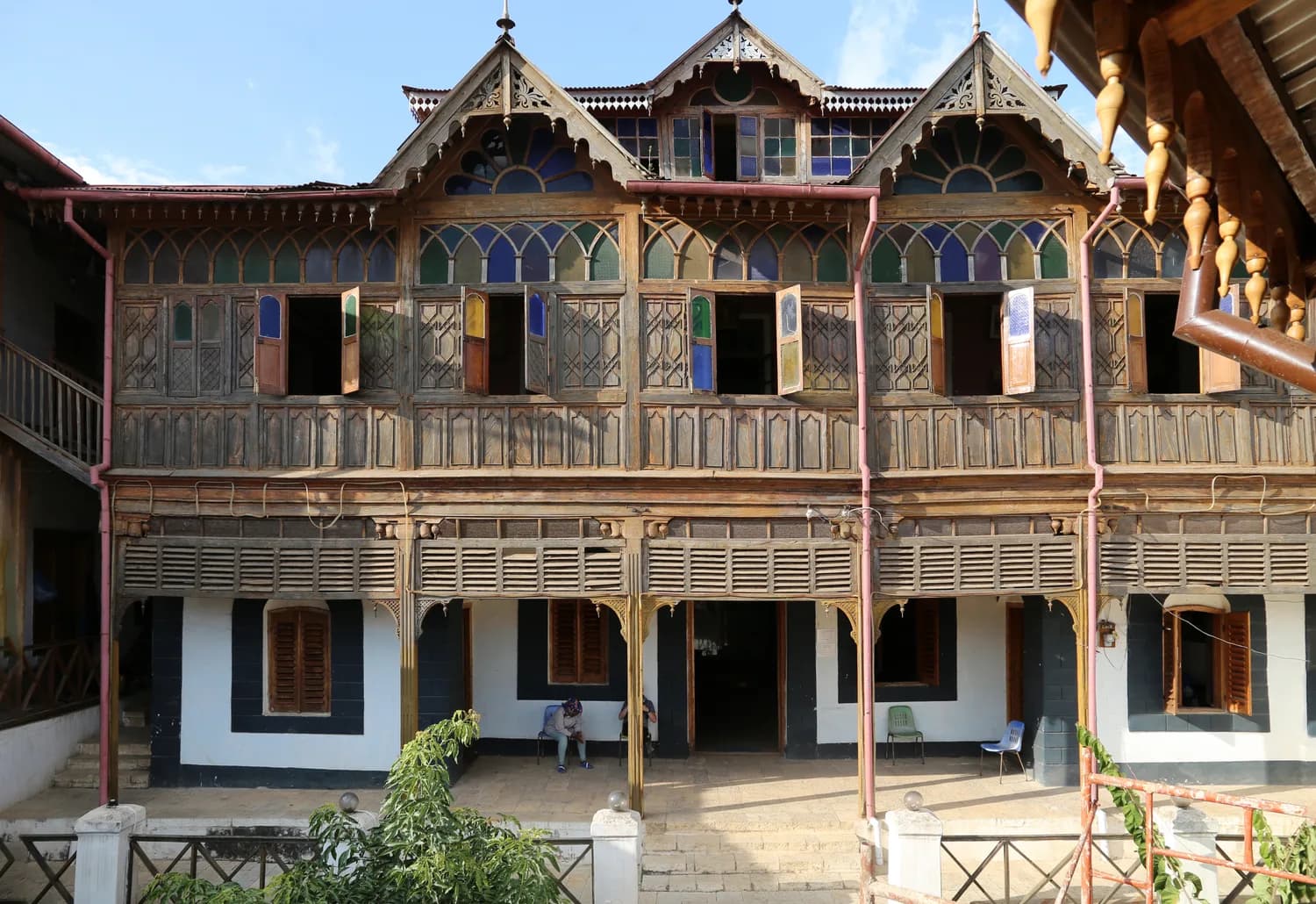
Harar itself had a long urban and religious history. UNESCO describes its distinctive townhouses and the interaction of African and Islamic traditions in its built environment. The later contributions of Indian merchants and craftsmen became part of an existing city, shaped through local use and adaptation. Architectural resemblance alone cannot identify a builder's language, regional origin or descendants.[17]
Objects also travelled from Africa towards India. Sana Mirza's study of a Qur'anic manuscript now at Princeton places its production in late eighteenth-century Harar and identifies a later endowment notice at Diu, naming Hasan ibn Adojo and his mother Fatima Shashu. This adds a connection through religious patronage and manuscript circulation. The precise route and the patron's biography remain uncertain. Diu is distinct from Kutch, so this object provides wider historical context without identifying a Kutchi migrant.[44]
British India and British-controlled Aden influenced these connections, but Ethiopia was not administered as a British colony. The British expedition of 1868 and Indian participation in the campaign ending Italian occupation in 1941 are additional histories of movement recorded by India's embassy. Military passage, commercial settlement and later professional employment must each be identified separately. None supplies an automatic ancestry for Ethiopia's present Kutchi families.[18]
7. After independence: staying, leaving and rebuilding
Kenyan independence in 1963 brought questions of citizenship and belonging to the centre of community life. The British parliamentary debate of 27 February 1968 records disagreements over obligations towards Kenyan Asians who held British passports and over proposed immigration restrictions. It is a primary record of those arguments, including the language used by ministers to justify restrictions. It should be read critically, rather than as an impartial account of migrants' choices.[19]
Randall Hansen's study of the 1968 crisis describes the rush to travel and the legislation that ended the unrestricted entry of the affected passport holders. This helps explain movement from Kenya towards Britain within the wider Asian diaspora. The policy did not target Kutchi speakers as a separate linguistic category, so it cannot tell us how many Kutchi people left or establish the circumstances of every family's departure.[20]
European records document the consequences of those restrictions. In its report adopted on 14 December 1973, the European Commission of Human Rights found that racial discrimination in admission amounted to degrading treatment for twenty-five applicants who were citizens of the United Kingdom and Colonies. Its conclusions differed for six British protected persons. This was a Council of Europe Commission report, made public in 1994, rather than a European Union decision or a Court judgment. It documents the wider East African Asian experience; it does not identify the applicants as Kutchi.[41]
A named woman's account gives onward migration a different scale. Gujarati Yatra's catalogue summary of Bhadra Vadgama's interview, recorded on 11 March 2017, describes Kutch ancestry, childhood in Zanzibar, marriage and teaching in Kenya, and later settlement in Britain. The summary identifies a family trajectory without supplying every migration date. Only the published interview synopsis was accessible for this study. It should be read as a retrospective account, with the recording and family documents still to be examined together.[42]
Departure is only part of the later history. Nairobi's Shree Cutchi Leva Patel Samaj describes migration by its members' ancestors in the 1890s and increased settlement after the Second World War. Its present account also records housing, education and medical support. This is an organisation's own history, with its own community focus. It shows the importance of institutions in making lives in Kenya and should not be generalised to all Kutchi groups.[21]
Recognition also entered the official record. Kenya's presidential proclamation of 21 July 2017 recognised Kenyans of Asian heritage as the country's 44th tribe. Its category is broad, encompassing people of different regional, linguistic and religious backgrounds. It is evidence of public recognition of an established Kenyan community, not a claim that these differences disappeared or that recognition began the community's history.[22]
Ethiopia followed a different political sequence. Harre connects departures in the mid-1970s with the Derg's nationalisation policy, while recording descendants who remained and people of Indian origin who held Ethiopian nationality. That evidence concerns particular Indian and Dawoodi Bohra histories. It does not justify a total departure figure for Kutchi families or the assumption that everyone left.[14]
Recent Indian migration to Ethiopia also needs to be distinguished from older settlement. India's embassy describes both late nineteenth-century arrivals from Gujarat and a later educational and professional presence. Those categories include people from many parts of India. A present-day Indian population estimate therefore cannot be used as an estimate of the historical Kutchi community.[18]
8. Language as evidence, and the work still to do
Language offers another way into the history. In an oral-history essay for the South Asian American Digital Archive, Omme-Salma Rahemtullah follows Kutchi through East African family life and later migration to North America. Her account discusses Swahili vocabulary within Kutchi and changes between generations. These observations come from a particular family and interview project. They suggest questions for further documentation, rather than a single linguistic pattern shared by every East African Kutchi community.[23]
A Mombasa judgment delivered in 2008 supplies a specific example of language use. In Abdulhamisi A. Salyani and others v. Rukiyabhai M. Saleh, the court accepted the woman's evidence that she understood Cutchi and Kiswahili. The acknowledgements were written in English, and explanations were said to have been given in Gujarati. The dispute shows why the choice of translation language matters. It establishes a repertoire described in one legal case, without supplying a migration history or a community-wide language rate.[45]
For Madhaaf, a useful next step is to record a journey together with the language and documents attached to it. A birthplace, an approximate departure date, an intermediate residence, a household language and a named source are more useful than an unqualified statement that a family came with the British. Conflicting memories should remain visible. The place a relative remembered as home may have been a village in Kutch, a neighbourhood in Zanzibar or a childhood house in Mombasa.
The next stage should bring together family correspondence, cemetery and religious-institution records, business papers, school records and interviews, with permission from the people concerned. Women's accounts and the experiences of people outside prominent merchant families are especially necessary. Ethiopian work needs the same care in identifying region and language, rather than inferring Kutchi identity from an Indian name or a Gujarati connection.
The expanded evidence supports a more detailed nineteenth-century history. Maritime records establish Kutch connections with the Horn and East African ports; Kirk's 1873 letter reports Memon arrivals in Mombasa around 1853; and the 1870 Bohra statistics explicitly record women and children. Later Kenyan notices document continuing sea trade and families connected with particular Kutch villages. Each source answers a different question. Earlier claims, including the reported 1705 captain, still require independent documentation, and the earliest household arrivals remain uncertain. Ethiopia's Kutchi settlement chronology and population also remain open questions.[34][36][38][39][40]
Archival coverage and remaining work
This investigation draws on publicly retrievable records checked on 22 October 2026. The register below distinguishes material inspected from holdings that need further retrieval. It does not claim a complete inventory of surviving evidence.
Read the search coverage and outstanding records
Kenyan records
Gazette scans for shipping, probate and family records; a Mombasa judgment.
Kenya National Archives microfilm finding aids identify Asian records, Mombasa association papers and Coast Province correspondence. Their original contents still require retrieval. No Kutchi-specific census total was verified.
British records
India Office correspondence, the 1870 administrative extract and parliamentary debates.
Kirk's working notebooks and further Mandvi–Mombasa correspondence are located through catalogues. Passenger and naturalisation searches have not established a complete migration series.
European collections
Guillain's French expedition account and the Council of Europe human-rights report.
Searches of EU, European and national portals established no new Kutchi-specific EU institutional record. French, Portuguese, German and Italian holdings remain unevenly digitised; a catalogue lead is not an inspected document.
Museums and heritage
Published studies of named museum objects and a Harar manuscript; a recorded interview's catalogue synopsis.
Accession registers, further recordings and National Museums of Kenya's Asian African Heritage holdings remain priorities. Object style or an institution's general exhibition description cannot establish a migrant's origin.
References / Evidence register
Sources and evidence
Numbered references connect the text and map to the material consulted. Access checked 22 October 2026. Access limits are recorded individually. These sources differ in purpose and scope; their categories and claims need to be read in that context.
- Primary text in translation
Sections 4–18 and 41–49. Evidence of trading geography; no claim of Kutchi identity.
- Scholarship: abstract consulted
Bibliographic record and abstract consulted. The full JSTOR article was not accessible in this review.
- Scholarship: abstract consulted
The accessible abstract supports the regional chronology and networks. Full article not accessed.
- Book: publisher's description consulted
Synopsis and contents consulted; book recommended for further research. No unexamined page-level claims are attributed to it.
- Archival interpretation
Dates of the 1824–1826 protectorate and the 1895 change; cites India Office Records IOR/R/15/1/39.
- Primary judicial record
Especially paragraphs 3–4. The host labels the report ‘Bombay High Court’; the text is a Privy Council appeal from Eastern Africa. Its community figures are reported, not enumerated by this study.
- Historical scholarship
Accessible page 336 consulted for communities and business relationships. Historical linguistic labels are not adopted uncritically.
- Historical and anthropological scholarship
Full online text consulted, particularly ‘Kutch–Africa marriages’. Colonial classifications and claims of benevolent slavery require critical reading.
- Historical scholarship
Introduction, especially printed pp. 1–3, consulted for Mijikenda trade and political agency. Book copyright date is 2025; the publisher lists release in December 2024.
- Research interview
Consulted for Aiyar's interpretation of colonial opportunities, exclusion and political divisions; the book itself was not fully reviewed.
- Museum interpretation
Workforce and labour conditions concern Asian and African workers broadly, not a Kutchi-specific population. Its opening generalisation about Asian origins should be read alongside the earlier merchant evidence.
- Family-history scholarship
Accessible introduction consulted for method and scope. Retrospective testimony is distinguished from contemporary records.
- Historical scholarship
Accessible opening text consulted for ports, goods and inland connections. ‘Indian’ and ‘Banyan’ do not identify Kutchi speakers.
- Scholarship using archives and oral history
Full article consulted. Particularly printed pp. 49–54 for origins, Aden and later departures. The issue's next article begins on p. 69.
- Scholarship using family documents and diplomatic archives
Full article now consulted, replacing the earlier summary-only access. Printed pp. 286–290 distinguish the two men, their Sidhpur origins, the 1940 letter and the son's account. The title's 1886 is not treated as a verified Harar arrival date.
- Author research paper
Full 17-page version consulted, especially pp. 10–12. Publication and peer-review status not established. The 2024 URL records hosting, not the date of the research.
- Heritage documentation
Used for the city's existing urban and architectural traditions. A building's style alone cannot identify a Kutchi builder.
- Official diplomatic account
Used for military episodes, later professional presence and its distinction from older settlement. Broad Indian categories are not Kutchi population estimates.
- Primary parliamentary record
Especially the exchange on Kenyan citizenship and British passport holders. Statements by participants are evidence of political positions, not neutral descriptions.
- Scholarship: chapter abstract consulted
Abstract consulted for the timing and consequences of the crisis. No Kutchi-specific departure figure is inferred.
- Community organisation's own account
Evidence of the organisation's account of its members' migration and institutions; not an independently verified history of all Kutchi people.
- Primary government proclamation
The category is Kenyans of Asian heritage, encompassing multiple languages and communities.
- Situated oral-history essay
Rahemtullah, Omme-Salma. ‘Tongue Tied.’ TIDES Magazine, South Asian American Digital Archive.
Used for the author's family and interview observations about language change. Broad claims about who speaks Kutchi are not generalised across religious communities.
- Historical and material-culture scholarship
Accessible article consulted, especially pp. 49–52 for Kachchh's textile production, African demand and the methods used. Evidence of exchange is kept distinct from household settlement.
- Primary travel report: digitised scan
Printed p. 196 (PDF page 10) identifies the Cutch Bohrah official; pp. 188, 196–197 establish the January 1857 journey. Contemporary observation, not a settlement register. Racist descriptions are not adopted as historical judgments.
- Primary trade return in a contemporary publication
March 1810 information supplied to Mr Stuart by Zeila's Baskatib. Page transcription and linked scan consulted; cited pagination belongs to the 1816 edition. The 200 bales cover a three-year summary; cloth origin is not evidence of merchant ethnicity.
- Primary commercial memoir: digitised compilation
Printed p. 215 (PDF page 258) for vessels, seasons, cargo and qualified slavery estimate; the same compilation prints the 6 February 1836 proclamation at pp. 310–311 (PDF pages 353–354). Source dates differ from the compilation date. No current annual slave total is inferred.
- Open-access analysis of a surviving navigational manuscript
Full online text consulted, especially ‘The manuscript’, ‘Acquisition history’ and ‘Dating’. RGS shelfmark mr Asia S.4. Manuscript age is approximate; acquisition in 1835 is secure. Historical chart imagery is not reproduced or assumed covered by the article's licence.
- Local historical account: earlier-settlement research lead
Printed p. 37 names Jusub Adam and 1705, but gives no document citation for that claim. Not independently verified or plotted as an established route. The article's separate identification of da Gama's pilot is not accepted here as proof of Kutchi ancestry.
- Primary voyage narrative in an edited translation
Printed pp. 40, 44–45 and notes 124, 130 for Indian vessels at Malindi; p. 181 is the editor's discussion of the pilot. Journal text and later editorial identifications are distinguished; neither proves a Kutchi settlement.
- Primary report based on sailors' information
Original scan consulted: printed pp. 26–27 (PDF pages 5–6) for the chart, May 1835 passage and Veerasil itinerary. Burnes reports information from its sailors and pilot; he did not accompany the African leg. Berbera identification follows Cooper and Rajani.
- Primary naval narrative: scholarly digital transcription
Darwin Online's Beagle Library transcription consulted for Mombasa merchants and Bombay trade. ‘Banyan’ is not a demonstrated Kutchi identity. The record header gives 1833; the transcription's title-page ‘1883’ is an error. Imperial self-justification requires critical reading.
- Primary travel narrative: transcription and later-edition scan
Chapter VIII, ‘Ten Days at Harar’, records Cutch canvas as gate duty. The searchable text is also available as Project Gutenberg eBook 6886. Pagination is edition-specific. A material connection is not a Kutchi settlement count; racial stereotypes are rejected.
- Primary consular report: scan and transcription
Arrival chronology comes from community leaders' recollections. Family residence is reported in 1873, not dated to 1853. The phrase about Sindhi descent and Kutch birth does not establish each resident's birthplace or language. His claims that slaveholding had ended require separate scrutiny.
- Primary memorandum based on an unnamed trader's account
Informant travelled on the coast during 1859–1866; the document expressly qualifies his numbers as rough estimates. Origins are reported collectively. Its denials of slaveholding and slave trading are attributed positions within a political dispute.
- Administrative statistics reproduced in a later compilation
Source chain established on printed pp. 13–14; Bohra table on p. 15 visually checked. Counts retain the categories adults, children and houses. No individual enumeration method or Kenya birthplace breakdown is supplied. Zanzibar Khoja family-origin figures elsewhere are not transferred to Kenya.
- Primary French expedition account: digitised original
Printed p. 267 (PDF 277) for Kutch/Bombay shipowners; pp. 372–373 (PDF 382–383) for firms and rotating agents. His earlier twenty-year estimate is reported information, not an exact founding date. Colonial classifications and judgments require critical reading.
- Primary customs notice: digitised scan
Table row dated 22 May 1923 identifies a dhow from Cutch Mandvi and red chalk cargo. The vessel-name lettering is uncertain, so it is omitted from the article. Cargo and port evidence supplies no passenger count or crew identity.
- Primary probate notice: digitised scan
Mavji Jivraj Vasta Patel of Nairobi, death at Kiriri, Uganda, 6 April 1959; widow Dhankuvar at Mankuva, Cutch; Gangdas Kanji Patel as attorney. Neither the attorney's kinship nor the widow's previous Kenyan residence is established.
- Primary family deed-poll notice: digitised scan
Kenya Gazette, vol. LXV, no. 21, 7 May 1963, p. 522, Notice 1986, ‘Notice of Change of Name’.
Masthead and scanned page establish 7 May, despite a misleading search-result date. Records a Nairobi father's daughters' births in Bharasar and Nairobi. This supplies family geography, not an exact migration date, citizenship history or language identification.
- Primary Council of Europe report
Printed pp. 62–64 (PDF 58–60), paragraphs 207–215. Article 3 finding concerns 25 UK-and-Colonies citizens; conclusions differ for six British protected persons. Official scan consulted. A Commission report, not a Court judgment or an EU record; Kutchi identity is unspecified.
- Heritage interview: published synopsis consulted
Synopsis identifies Kutch ancestry, Zanzibar childhood, teaching and marriage in Kenya, and later Britain. Recording and full transcript were not accessible in this investigation. Exact migration years and home language are not inferred.
- Scholarship using family papers, court records and museum objects
Full online text consulted, especially ‘Between three coasts’ and figures 2–3. Peabody Essex Museum bracelet E22365.A and portrait TR2016.13. Provenance follows the published study; accession registers were not independently inspected. Regional women's history, without a demonstrated Kenya route.
- Material and manuscript scholarship
Published analysis and illustrations consulted. Princeton Islamic Manuscripts, Third Series 900q, catalogue 99125500439306421. Late eighteenth-century dating is an attribution; a different written date is considered unreliable. Patron biography and itinerary remain uncertain. No Kutchi identity is established.
- Primary judicial record: full reproduction consulted
Unnumbered passage discussing acknowledgements and the defendant's languages; search ‘mother tongue Cutchi’. Official citation checked through Kenya Law metadata; accessible full text read on SheriaHub. This records one woman's evidence and the court's assessment, without a migration chronology.
- Primary parliamentary exchange
Full exchange consulted for segregation, representations by Indian associations and residential land. Questions and ministerial justifications retain their attributed status. The record does not identify a Kutchi subgroup or enumerate affected households.
Image and map credits
- Figure 1: Camaal Mustafa Sikan… (credit as recorded by the source), Mandvi Ship Making, originally uploaded 19 April 2008. CC BY 3.0. Reproduced without alteration; the header uses a display crop.
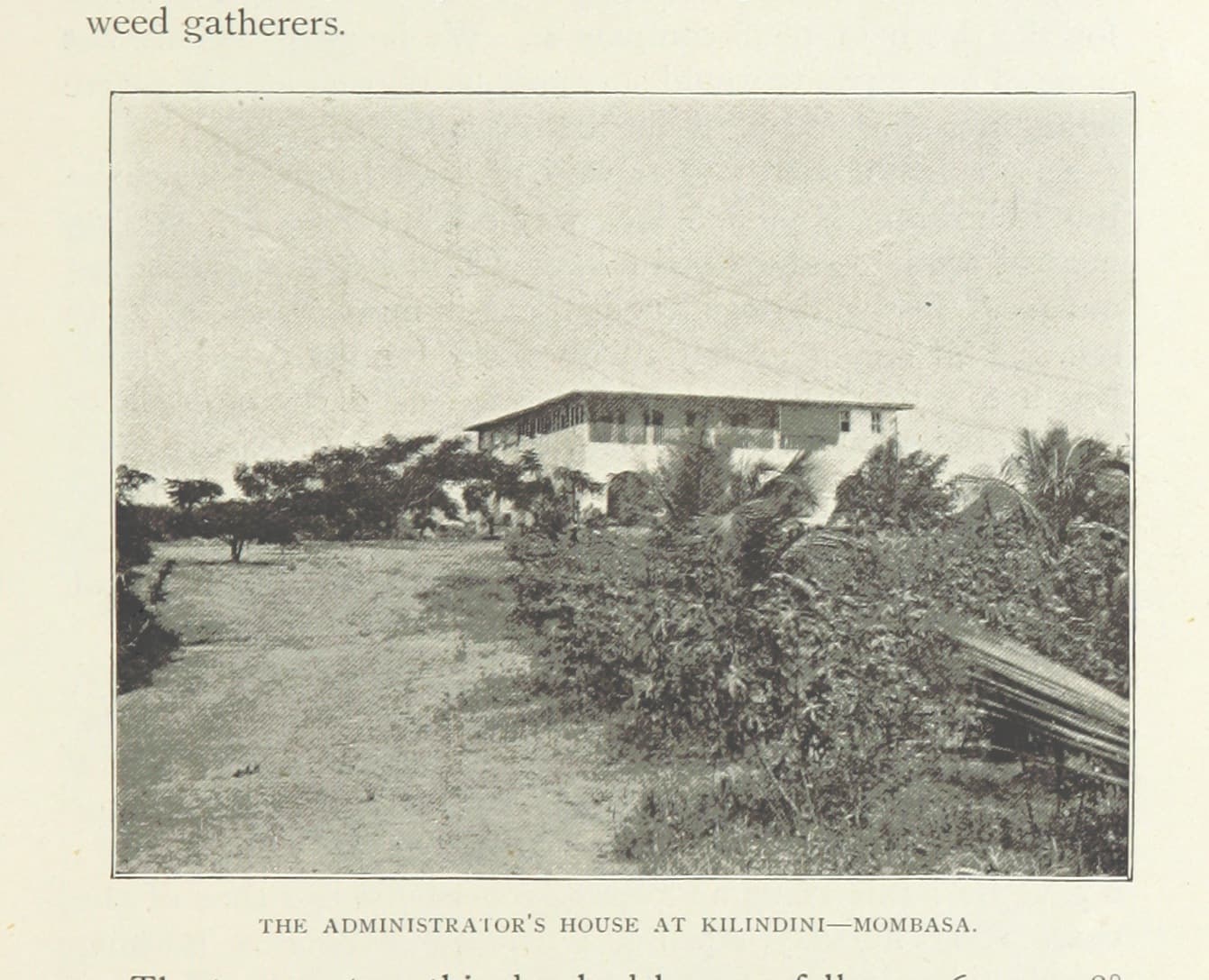
- Figure 2: British Library digitised illustration from Fitz Gerald's 1898 book, scan page 445, shelfmark Digital Store 010095.f.6. The British Library's Flickr Commons release records no known copyright restrictions. Reproduced without alteration.
- Figure 3: Sailko, Harar, casa di Rimbaud, 05, 8 November 2018. CC BY 3.0. Resized and converted to WebP; no content changes.
- Map: Natural Earth 1:110m land, public domain. Coastlines simplified for this display. Connections are editorial interpretations tied to the numbered sources, with no claim to exact historical tracks, boundaries or migration volumes.


Cite this article: Abdulla, Farhan. 2026. “Across the ocean: Kutchi histories in Kenya and Ethiopia.” Madhaaf, 22 October. https://madhaaf.vercel.app/history/kutchi-diaspora-kenya-ethiopia.